“Joe Walker, creator of Direct Web Remoting (DWR) , has been summing up the reasons that as he thinks have lead the Web to become the default development platform over the last years. Easy of deployment, simple UI programming, simplicity of HTML and Openness made the Web become the most scalable system today.”
“Mark Reinhold, Principal Engineer at Sun Microsystems, has been advocating about how “cool” would be for the Sun JDK to be modular. He’s is putting up a good argument about how the complexity is hurting the platform and how the Java Kernel and Quickstarter features in the JDK 6u10 release just address the symptoms of JDK’s long-term interconnected growth.”
“QCon San Francisco 2008, hosted a panel on Open Standards Development where Patrick Curran, Chair of the JCP and distinguished members of the community, shared their practical experiences both on open standards and open source development. Almost from the beginning it became evident that there were two major issues that would dominate the discussion: Openness and Ease of entry level participation to the JCP.”
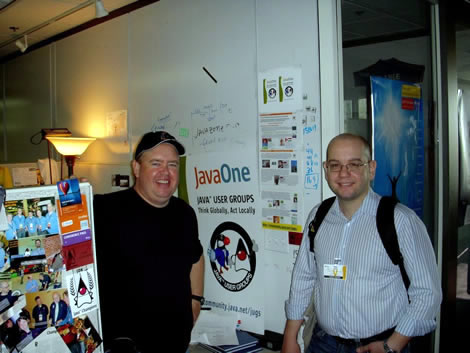
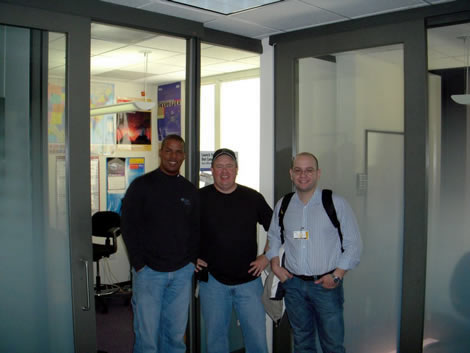
While visiting San Francisco for QCon SF 2008, I had the opportunity to get a tour of Sun’s Campus in Menlo Park from my friend Aaron Houston. Aaron is the Program Coordinator for the Java User Groups (JUGs) has been supportive of the efforts of the Greek JUG (JHUG). He is also an avid supporter of the Java Champions project.
In order to get there I had to take the Caltrain from SF Station to Menlo Park.
At Menlo Park Station Aaron picked me up and we drove up to Sun’s Campus. There I had
the chanch to see where all the JUG magic is being done and also meet Mark Dehart.
I also had a chance to meet with Reginald Hutcherson who is a Java Evangelist that has been regularlyvisiting us in Athens, Greece with his team.
We also visited the office of Doris Chen, one of our beloved Java Evangelists, but she wasn’t there.
After that we walked through various places of the campus, one of which was the exhibition center, AKA Geek Disneyland.
One of the things that also impressed me was the cafeteria that employees had their lunch. Talk about choices! BBQ, Oriental, American, vegetarian and huge selection of bevereges. I could definetly gain (even) more weight here 🙂
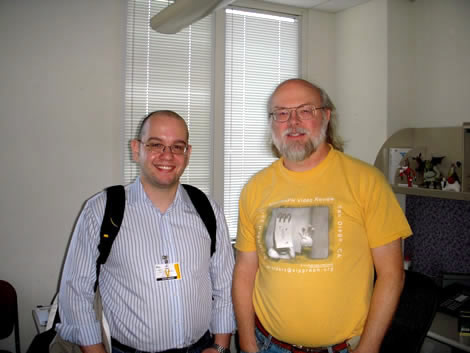
As we were going through corridor after corridor, Aaron stuck his head in a door and started to talk to some employee. At some point of the conversation I heard the name “James” and immediately notices the sighn next to the door “James Gosling”. This was actually the pinnacle of my visit there. I had the chance to pay my respect to the father of Java and invite him to visit us in Greece.
This was actually the pinnacle of my visit there. I had the chance to pay my respect to the father of Java and invite him to visit us in Greece.
Ola Bini, a core JRuby developer and author of the book Practical JRuby on Rails Projects, has been developing a new language for the JVM called Ioke. This strongly typed, extremely dynamic, prototype based object oriented language aims to give developers the same kind of power they get with Lisp and Ruby, combined with a nice, small, regular syntax.
After being in beta for about a year and having more than 1 million downloads, the Java SE 6 Update 10 (6u10) , dubbed the “Consumer JRE” has been released. With this release which is primarily focused on the Java Plug-In, Sun is trying to deliver on its promise for an enhanced rich client user experience and paves the way for the upcoming JavaFX Desktop 1.0.
The Large Hadron Collider (LHC) is a particle accelerator that aims to revolutionize our understanding of our universe. The Worldwide LHC Computing Grid (LCG) project provides data storage and analysis infrastructure for the entire high energy physics community that will use the LHC.
The LCG, which was launched in 2003, aims to integrate thousands of computers in hundreds of data centers worldwide into a global computing resource to store and analyze the huge amounts of data that the LHC will collect. The LHC is estimated to produce roughly 15 petabytes (15 million gigabytes) of data annually. This is the equivalent of filling more than 1.7 million dual-layer DVDs a year! Thousands of scientists around the world want to access and analyze this data, so CERN is collaborating with institutions in 33 different countries to operate the LCG.
It has been several months since we got together with Panagiotis and Christos to make a Firefox plugin that would allow us to send status updates simultaneously to multiple social networks and services, like Twitter, FaceBook, etc. As a part-time project (actually one of many part-time projects I’m constantly working on), it took us a while but we have a beta version out.
“The newly announced TraceMonkey is a trace-based JIT compiler that will be featured in the next release of Firefox and pushes the envelope on JavaScript performance. InfoQ has a Q&A with Mozilla JavaScript Evangelist and jQuery creator John Resig about this exiting development and what it signifies for the future of JavaScript-based RIAs.”
“The Mozilla Foundation has developed TraceMonkey a trace-based JIT compiler that pushes the envelope on JavaScript performance. With plans to be incorporated it in the 3.1 release of Firefox, it delivers near C performance and promises to ‘leap frog’ RIA development to a new level.”
Building a Web App with SpringSource Application Platform (Demo)
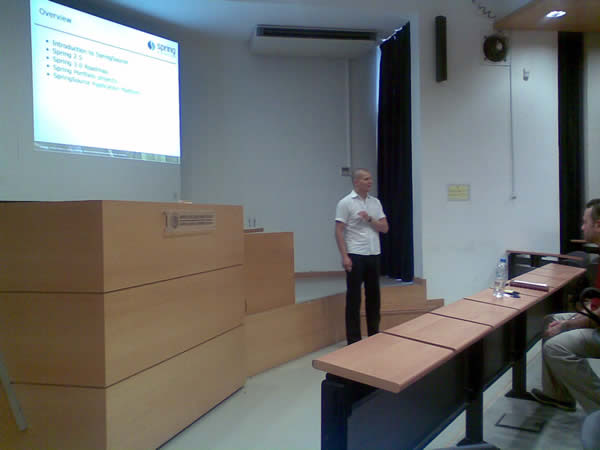
Although there was a severe heat wave and most people are still on vacations the turnout proved very good and Iwein created a warm and friendly atmosphere. Participants left with several Spring leads to investigate the following days.
Oracle has announced the release of WebLogic Server 10g R3 which is the first release of BEA’s Application Server since its acquisition by Oracle earlier this year.
This version adds support for Java SE 6, Spring, Comet, improved Operations Control, FastSwap Deployment and more.
The Dojo Toolkit is a modular open source JavaScript library, designed to ease the rapid development of JavaScript or Ajax-based applications and web sites. InfoQ had a Q&A with Dylan Schiemann, CEO of SitePen and co-creator of the Dojo Toolkit, about AJAX, Comet, Bayeux, RIAs and the newly released Dojo Toolbox.
Since attaining a peak of about 95% usage share during 2002 and 2003, Internet Explorer 6 (IE6) has been rapidly losing market share. As the end of 2008 approaches, significant online services, vendors and web frameworks are dropping support for IE6 (Apple, 37signals, etc.)! Will this (finally) year be the end of IE6..?
Includes original quotes by:
Douglas Crockford, senior JavaScript Architect at Yahoo and creator of JSON
John Resig, who is a JavaScript Evangelist for Mozilla and creator jQuery
Dylan Schiemann, CEO of SitePen and co-creator of Dojo
Jeffrey Zeldman author of several books on web design and co-founder of the Web Standards Project
“An industry wishlist for future browsers has been collected and developed by OpenAjax Alliance. Using wiki as an open collaboration tool and with contributions from many people in the industry, the feature list now lists 37 separate feature requests, covering a wide range of technology areas, such as security, Comet, multimedia, CSS, interactivity, and performance. The goal is to inform the browser vendors about what the Ajax developer community feels are most important for the next round of browsers (i.e., FF4, IE9, Safari4, and Opera10) and to provide supplemental details relative to the feature requests.”
After a rather long development cycle the JBoss AS 5 RC1 is only a handful of days away from its release. InfoQ caught up with project lead Dimitris Andreadis to discuss the new features and release timeline. Dimitris also comments on Java EE 6 features, the advantages of JBoss AS with respect to competition and their choice of having a pluggable components model instead of sticking just to OSGi:
The Grizzly framework is used in multiples products like GlassFish, Sailfin, RESTlet, OpenESB and many more, where it enables developers to write scalable server applications, by leveraging the Java New I/O API (NIO). Atmosphere, an evolution of Grizzly, is a POJO based framework that aims to bring Comet to the masses. Jean-Francois talks to InfoQ about this new development:
“JBoss Cache is an enterprise-grade clustering solutions for Java-based applications, that aims to provide high availability and dramatically improve performance by caching frequently accessed Java objects. In this post InfoQ has a round-up interview with project lead Manik Surtani.”
The early draft for JSR 314 has been released for review under the Java Community Process Program. This JSR aims to update the 1.2 version of the JavaServer Faces specification to version 2.0. This next generation of JSF is an attempt to bring the best ideas in web application development to the Java EE platform and is already receiving positive feedback from the community, especially because of its improved AJAX support….
For the last time before summer, the Java Hellenic User Group (JHUG) organized an excellent event for the Greek developer’s community. Participation was high and I was very excited to meet again several friends and old colleagues, like Panagiotis, Christos, Thanassis, Ioannis and Spyros (sorry if I forget someone).
The event started of with Paris giving out a small introductory and several Java goodies like t-shirts an books.
Here is a short outline of the talks that followed:
Mikhail Kondratyev – Netbeans (NB) 6.1 Overview
Intro to NB 6.1
Focused mostly on Java features
Gave a short history of the NB IDE
New features of 6-6.1:
Added run configurations
Better deployment for Java Web Start
Added test libs
Better support for shared libs
Jemmy test framework
Project Groups
Several Editor enhancements
Local History
MySQL support
Restful WS (generate JavaScript stub!)
Integrated Mercurial support
Upcoming for 6.5 (planned for end of September)
Better PHP
Client JavaScript debugger for Firefox (IE6/7/8?)
Integrated Groovy
Even better MySQL tooling
Mark Newton – JBoss Community & JBoss AS 5
Mark gave a nice talk on the evolution of the JBoss business model and how it fits with the open source community.
Kirk Pepperdine – Performance Tuning and Java Optimizations
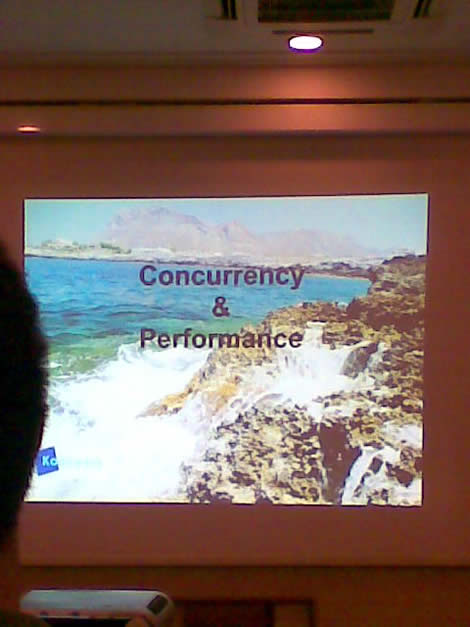
Kirk kicked a** as usual, explaining how multiple cores are changing the fundamentals of how we code:
Sequential programming is hard but… concurrent is harder
Multicore redefine the rules for coding, design and architecture
Explained the “Quake Principle”
We will have to adjust algorithms to hardware, as in the past
Moore’s law revisited: Double parallelism every 18 months
1000 cores within this decade
DBs don’t scale good on clusters – a 20 year old technology
Manik Surtani – JBoss Cache: Clustering enterprise Java for scalability and high availability
Manik’s visit to Greece, was a very good opportunity to chat with him and arrange for an interview/acrticle for InfoQ about JBoss Cache. During his talk he presented the benefits of caching and also the common pitfalls. He also presented several features of JBoss Cache and common architectures for high availability.









 Oracle has announced the release of WebLogic Server 10g R3 which is the first release of BEA’s Application Server since its acquisition by Oracle earlier this year.
 The
The 
 “An industry wishlist for future browsers has been collected and developed by OpenAjax Alliance. Using wiki as an open collaboration tool and with contributions from many people in the industry, the feature list now lists 37 separate feature requests, covering a wide range of technology areas, such as security, Comet, multimedia, CSS, interactivity, and performance. The goal is to inform the browser vendors about what the Ajax developer community feels are most important for the next round of browsers (i.e., FF4, IE9, Safari4, and Opera10) and to provide supplemental details relative to the feature requests.”
 After a rather long development cycle the JBoss AS 5 RC1 is only a handful of days away from its release.



 Dio Synodinos