Eclipse is to NetBeans what Linux is to Mac OS X

While attending the “Java Developer Days in Athens” with my good friend Christos Stathis, he suggested that the differences between Eclipse and NetBeans are similar to the differences between Linux and Mac OS X. He had come to this analogy as he was evaluating both products for the company he works for and while his comment was a bit witty I feel he had a strong point.

Just think about it:

Eclipse:

  • it seems more configurable
  • it has a multitude of third party components…
  • …most of which are free to use but…
  • … many times have overlapping responsibilities or…
  • … don’t perform as good as advertised
  • it lacks the “sexiness” factor these days

NetBeans:

  • comes in a more monolithic form
  • most of the stuff you’ll ever need either came along with the original package or…
  • … are produced by the same company (packs) and because of that…
  • they are surprisingly stable and well integrated
  • is currently hot hot hot!

Just as you know, since the presentation of the new NetBeans (v5.5) that Roumen Strobl and Geertjan Wielenga gave in Athens in late December I have switched most of my work from Eclipse to this IDE. Not 100% satisfied since there is a lot room for improvement especially in the editor, but I feel it is in the right direction and I am eagerly waiting for v6.

Social Bookmarks:

Quickie: The latest article got linked from java-champions.dev.java.net… wow!

This post serves as a notice that the previous one (What happened during the “Java Developer Days in Athens” event) is (at the movement) mentioned in the front page of Java Champions page.

This is an honor and a surprise since I didn’t expect to get such an attention. This event was the 2nd one by Reginald’s team I have participated in, and since I have enjoyed it I though it would be nice to share with the rest of the community of java developers.

If you don’t know yet what “Java Champions” are, it is group of influential Java leaders that through a nomination process have been selected for their outstanding contribution to the Java community. They are about 70 around the world and you can find a bit more about this group from this excellent post from Yakov Fain regarding his nomination. BTW if you are a developer and haven’t subscribed to Yakov’s articles then you are missing some of the most insightful free material available on the web today.

Finally I would like to mention that we are lucky in Greece to have our own Java Champion living in Crete, Dr. Heinz Kabutz. His “Java Specialists’ Newsletter” is for notorious for its rather unconventional insights about Java; “make Java do things you thought it could not” 🙂

Social Bookmarks:

What happened during the “Java Developer Days in Athens” event

Today I attended the “Java Developer Days in Athens” event held in Athens Information Technology (AIT), along with my good friend chstath. Some from the team of speakers were familiar to the greek audience. I still remember a “colorful” presentation back in 2001-02 held at the NTUA 🙂

The facilities at AIT where excellent, the speakers where motivating and I had the opportunity to see friends, people from JHUG, former colleagues and even an old friend from the army. The turnout was massive so the participants filled a large auditorium and at least 2 classrooms that had direct video connection.

Panoramic shot of the auditorium

Most of the people stayed until almost the end of the event, which is something I’ve rarely seen.

I will try to give a short overview of this exciting event, for those that couldn’t attend.

Keynote by Reginald Hutcherson

  • Mentioned an array of popular organizations that are know for their large scale java deployments (yahoo, google, youtube, ebay).
  • The motto he repeated many times was “It’s a lifestyle”.
  • Gave a short description of the Web 2.0 ecology.
  • Spoke about the emerging concept of having one virtual machine for all languages: java, php, ruby, etc.
  • Said that any software tool in the future will be deployed through NetBeans.
  • Suggested that with open sourcing java (along with other products like OpenSolaris), SUN became one of the biggest open source contributor in the world.
  • Since Duke was open sourced… people are doing some strange things with it.

Cool Demos by Simon Ritter, Doris Chena and Angela Caicedo

  • JSF, AJAX, NetBeans Flower Shop Demo (similar to Java EE 5 blueprints)
  • “Nasa Rover at your pocket” – Angela remotely manipulating a robot from her Java ME enabled mobile phone. Basically web services from a Java ME client (see NetBeans Mobility Pack).
  • “Search Inside Music” – Automatically create an mp3 playlist based on “audio fingerprint”. Finds similarities based on voice recognision.
  • SUN SPOT (Programmable Objects Technology) – Infrastructure for wireless network sensors. At some point the speaker used a virtual glove (see “Minority Report”).

Feedback from the community

  • Presentation of the JHUG:

Java SE Language Past, Present, Future by Doris Chen

  • Java SE 6
    • Timeline of Java
    • Said that in the future there will be no short maintenance releases but rather major releases every 6-8 weeks
  • Java SE 7 (H2 2008)
  • Reasons for migrating to v6
    • No major migration issues from 1.4 and later
    • Binary backwards compatibility
    • Client/Server Benchmarks show Tiger fast, but v6 FASTER
  • java.net description
  • Short explanation of the new licensing:
    • GPL2
    • +Classpath exception
  • Overview of many new features of v6 (a dozen o JSRs)
    • Personal favorites:
      • Password prompt for console. No more GUIs just for the sake of hiding a password
      • Classpath wildcards like “*”… but be careful if you need class loading in a specific order
      • Jconsole looked sexy
      • The new Desktop class (java.awt.Desktop) promises to speed up trivial tasks
      • Splash Screen for java apps (cool!). Even from prompt: java – splash:my.gif MyApp
      • Customized Tray Icon (cool again!).
      • Auto-update: Nice but still not as sophisticated as it should be
  • Some new features of Java 7 like inclusion of dynamically typed langs

Every time I attend an event where the speakers come from diverse cultures, I enjoy listening to the different accents. Actually I have a very flat Greek/Spanish accent that is typical of the region I come from. Well, Doris had an intriguing oriental accent that sometimes was… funny, hence emerged the joke “I know that the oriental cuisine is one of the best in the world but… what is all that about the `sauce code`”.

BPEL & SOA by Simon Ritter

  • What are “Services”
  • … “Service Oriented Architectures
  • What do Services do
  • Service Implemntation Tehnologies: The ecology
  • “Principles”
  • Descripion of “Composite Apps”
  • Bussiness Process Requirements and
  • NetBeans demo

Java ME for phones and devices

  • Intro to Java ME today, “The Big Picture”
  • A new acronym for me: JTWI
  • MSA (JSR 248) (they finally got it)
  • <At this point the coffee stopped having an effect on me due to a heavy lunch>

Solaris by Simon Ritter

Since it was a SUN event, it was expected to see something about Solaris. Although the presentation had nothing to do with Java, Simon managed to capture our attention with some cool stuff that come along with the new Solaris, like DTrace (3500 probes available also in Java).

Dynamic Proxies by Dr. Heinz Kabutz

Web tier with AJAX

  • What is AJAX
  • Autocomplete demo using a servlet (raw AJAX)
  • Description of toolkits
    • JSF Components
    • Client-side javascript libraries
    • Wrapper: jMaki (hot!)
    • Java to javascript translator (call me GWT)
    • Remoting via Proxy (DWR)


More information (in greek) regarding the event…


Social Bookmarks:

Trivial discussions in IT and Parkinson’s Law

The last weeks I have been following a long discussion regarding choosing one logo over another. Since most of the available logos looked decent it was surprising to see the vast amount of feedback regarding such a trifling issue.

Actually the phenomenon is ubiquitous in discussions between more than a couple of people, especially in IT. It is no surprise then that there is a specific terms in the FreeBDSD nomenclature: the “Bikeshed”

From the FreeBSD Mailing Lists FAQ:

…the word is a derogatory term that refers to any oft-recurring discussion about a particular subject; in particular, it is most often used to refer to a topic which has never reached a consensus within the FreeBSD community. A bikeshed is a topic that will tend to generate immediate meta-discussions and flame

An even better examination of this phenomenon can be found at C. Northcote Parkinson’s 1960 book called “Parkinson’s Law.

Parkinson shows how you can go into the board of directors and get approval for building a multi-million or even billion dollar atomic power plant, but if you want to build a bike shed you will be tangled up in endless discussions. Parkinson explains that this is because an atomic plant is so vast, so expensive and so complicated that people cannot grasp it, and rather than try, they fall back on the assumption that somebody else checked all the details before it got this far. A bike shed on the other hand. Anyone can build one of those over a weekend, and still have time to watch the game on TV. So no matter how well prepared, no matter how reasonable you are with your proposal, somebody will seize the chance to show that he is doing his job, that he is paying attention, that he is here.

The whole “bikeshed” issue reminds me of a more general phenomenon: everyone has an opinion, as an infamous quote suggests 🙂


Social Bookmarks:

JHUG meeting 2007-01-21

Today, while developing flu symptoms, I attended the meeting of the Java Hellenic User Group (JHUG). It was a friendly gathering in a cozy café in the center of Athens. The discussions ranged from internal matters, to stories from people that attended JavaPolis 2006, to upcoming events that are organized by the JHUG and more.

As it is mentioned in java.net “Java User Groups (JUGs) are local communities of Java users who get together to share information, resources, and solutions and to network together”. Additional information regarding the activities of the group can be found at: http://www.jhug.gr.


Social Bookmarks:

You can find bad programming practices even in the most popular deployments

  1. Even though it is essential to print ANY type of errors and warnings (even simple notices) in development mode, these things should not be served to your clients.
  2. Handle errors gracefully and provide a “plan B” for when something fails. It is elementary to handle IO errors (file inclusion, network/DB communication, etc.).

oreilly-blog-small.jpg

Social Bookmarks:

Yes… there are non-XML standards too!

It is late night at home and while I’m browsing a bunch of JavaPolis 2006 presentations, a piece by John Davies on ESBs in investment banks reminds me something that you rarely hear these days:

You cannot do everything in XML!

There are a lot of issues with XML like unacceptable latency for demanding systems. The investment banking industry that is featured in John presentation is a good example where you need non-XML standards like SWIFT FIN, FIX, CREST/DEX and ISO, TRAX, OMGEO etc.

Talking about banking software, John has made this interesting podcast about the (java) investement banking s/w stack that has sparked some controversy in TheServeSide forums.

Social Bookmarks:

World’s smallest Web Service’s demo using NetBeans

(Recently I had to give a small training on Web Services so using this straightforward article I came up with a bare-bones Web Service’s demo using NetBeans)

Prerequisites

Install Java EE 5 Tools Bundle which includes NetBeans IDE 5.5, NetBeans Enterprise Pack 5.5, Sun Java System Application Server PE 9 and more.

Note: The Java SE Development Kit 1.5.0_09 (JDK) is required to install this bundle.

Build The Service

  • Create New Projects
  • Right click -> New Web App -> Java version 5
  • Right click -> New Web Service (eg. CalculatorWS)
  • Add method:
    @WebMethod

    public int add(@WebParam(name = “i”) int i,
    @WebParam(name = “j”) int j) {

    int k = i + j;

    return k;

    }
  • Deploy

To test the service

http://MY_SERVER:8080/PROJECT_NAME/CalculatorWSService?Tester

The Java SE client (consumer)

  • Create New Project (no spaces in path!) -> e.g. “CalculatorWS_Client_Application”
  • Right-click New > Web Service Client.
  • Insert WSDL URL:
    http:// MY_SERVER:8080/PROJECT_NAME /CalculatorWSService?WSDL
  • Right click inside class -> Resources > Call Web Service Operation
  • Browse to the “add” operation and click OK
  • Give values e.g. port.add(3,4)
  • Rigth click client -> Run (it should print 7 – wiiihaaa!)


Social Bookmarks:

AJAX raises security issues (aka not a “disgruntled AJAX evangelist”)

On my last post I received heat from a reader who suggested that I was being bias in favor of AJAX. I like AJAX and as I have written in 2004 for DDJ even before the acronym was invented, it “will have a profound impact on the web-user-interface-design paradigm for years to come”. To be honest though there are a lot of things that worry me as I see AJAX sites and services sprouting around. One of those things is security. Transparent asynchronous communication with the server from a web page makes it easier to launch several types of attacks. A very interesting incident was the propagation of the samy worm that managed to bypass numerous security restrictions and catch the MySpace Team unprepared.

Today I received a request for review for the “OWASP Testing Guide v2.0” which seems like a decent approach towards providing a tool case for security experts and developers. As many others have pointed out, as web applications become ubiquitous in our daily lives the need for security becomes more eminent and this need requires that security considerations be included as early as possible in the software development lifecycle!

Social Bookmarks:

Quick thoughts on “The eBay Architeture – Striking a balance….”

Just finished reading through this PDF presentation by Randy Shoup and Dan Pritchett. A really interesting view in the operations of one of the largest e-commerce deployment in the world – maybe the biggest. Here are some things that left an impression:

  • The numbers regarding daily transactions, users, LOCs etc. are stunning.
  • Their commitment on horizontal scaling. Still in 2007 designs for horizontal scalability are scarce.
  • “Limp mode” for business features if a failure occurs.
  • Original version of eBay build over a weekend.
  • In 2002 they chose to “re-write the entire application in j2ee”
  • … but threw out most of it (j2ee) in order to scale better (g. re-write connection pooling)
  • Abandoned transactions (client-side/distributed) in order to achieve better scalability – “created alternate DB structures”
  • Horizontal splitting of their DBs
  • No stored procedures – only simple triggers
  • CPU intensive (eg. data integrity) work taken away from the DB to the app
  • Application tier completely stateless (obviously)
  • Developed their own ORM technology – DAL: Data Access Layer
  • Real-time indexing (using messaging?)
  • Entire site automatically rolled-out every 2 weeks
  • Scalability is king!
Social Bookmarks:

About the tagline of this blog

A reader noticed that the tagline of this blog bears a resemblance to C.A.R. Hoare’s law:

Inside every large program (problem) is a small program (problem) struggling to get out.

or Rhode’s corollary to Hoare’s Law

Inside every complex and unworkable program is a useful routine struggling to to be free.

More about this ACM Turing Award winner can be found here.

The idea for the tagline came from reading a post in the blog of yet another extraordinary individual.

Choosing technology/language/framework for web application is not rocket science, but…

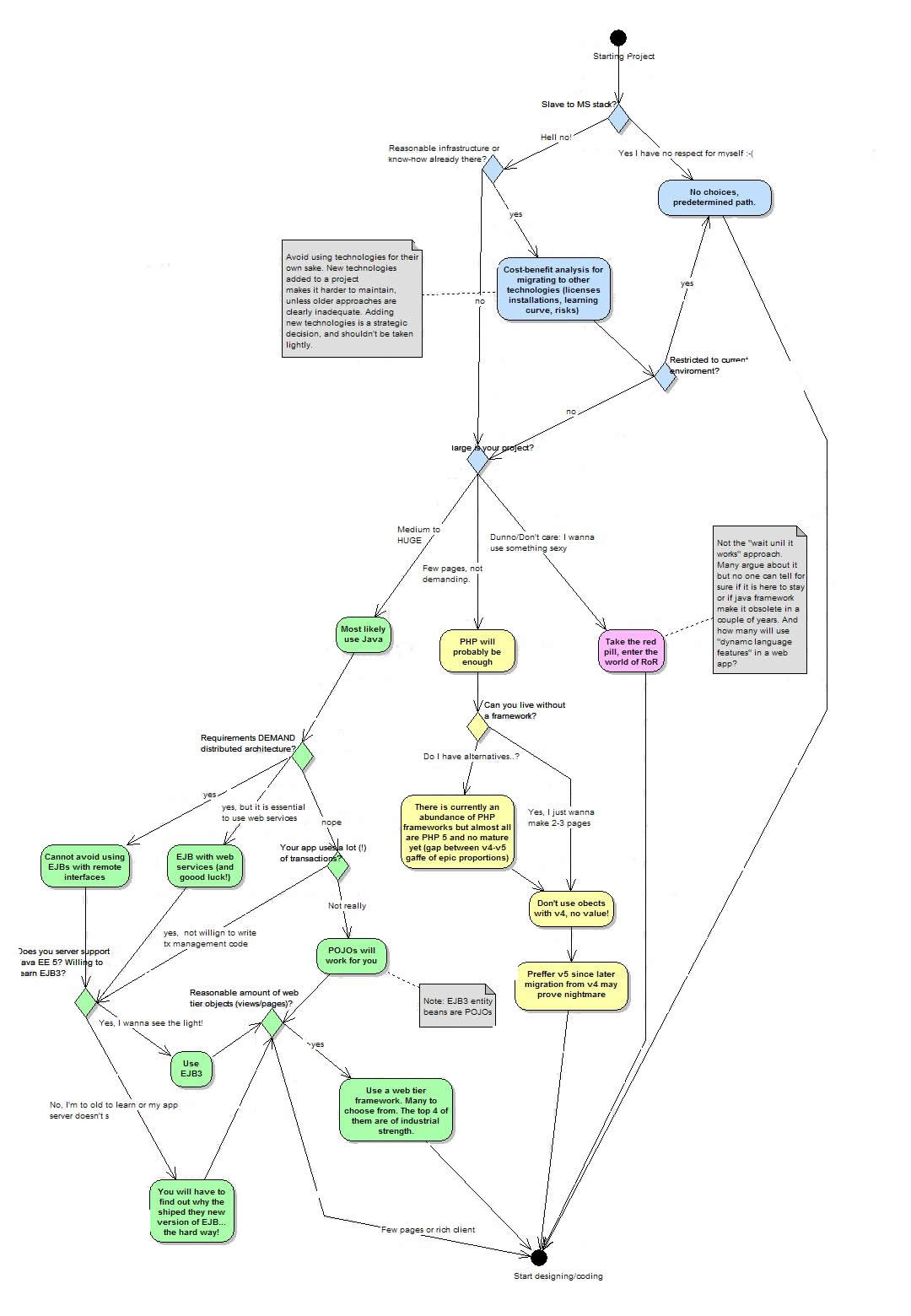
Discussions about which servers-side platform is better for web development are common in my workplace. Since I don’t like to repeat myself I have made this activity diagram that shows a simple overview of the process of choosing a platform for a web application. The bottom line is that there is no “swiss army knife” for this genre of applications. Every project should be approached independently and the architectural choices must be based on its requirements (and not your resume).

activity-diagram-w400.jpg


PS: Never let junior staff make architectural decisions!


Thoughts on the book: “Virtual society? Technology, Cyberbole, Reality“

Just before the summer I had to write a small review about this book. Although at the beginning the verbose academic language was hideous, as I continued I found that the sociological perspective of current IT trends can become intriguing. Especially for someone coming from an engineering background like me.

What follows is a small piece of my review:

Prologue

As our societies march forward in the uncharted territories of the new millennium it becomes eminent that almost all aspects of social, cultural, economic and political life stand to be affected by the new Information and Communication Technologies (ICTs). It is not rare nowadays for governments and major national funding agencies to conduct extensive and expensive research in social effects of ICTs. This concern about the social impact of new technologies by governmental agencies is not only fuelled by mass media and businesses interest but also aided by the success of social science communities to demonstrate the value of the results of their work in the field.

The Virtual Society? contains 17 articles based on exciting body of research conducted by British scholars, except one contribution from the USA. In the first week of May 2000, some 130 researchers (mostly social scientists) gathered in Ashridge House near London to discuss the new information and communication technologies’ impact on everyday life and society in general. 47 presentations and 4 keynote speeches were given during the two-day conference. The Virtual Society? Program was founded in 1997 and was headed by Professor Steve Woolgar of the Brunel University. It united 22 individual projects at 25 universities in Great Britain. The Economic and Social Research Council (ESRC) financed the program with 3 million pounds. As the program came to an end in 2000, the conference was an opportunity for the project members, who gave approximately half of the presentations, to reflect on their work and compare it with research activities in other countries. Contributions came from such countries as Canada, Denmark, Finland, France, Germany, Ireland, the Netherlands, Norway, Russia, the USA and Yugoslavia. Four parallel sessions addressed various political questions (e.g, participation rates, privacy, cyberethics) in different everyday contexts (e.g., teleworking, e-learning, telemedicine) and in relation to different social groups (e.g, non-users, net drop outs, female users). Socialpsychological concepts often played a key role here.

The book covers the following issues: ICTs use in various contexts, economic and political aspects, attitudes towards surveillance, role of ICT in education, concept of virtuality, particularities of organizational adoption of ICT and provides interesting findings that dissolve the dominating prejudice and uncritical speculations about media, networks, information society, internet, and such. It is based on a sound empirical study offering deep analysis of the results and reflects the impact of ICTs on society, and also the impact of social environment on the ICTs development and application. The most unconventional results reveal mutual influences among people’s behavior shaping the use of ICTs and ICTs changing human behavior within a recognizable social environment.

This publication is structured around the five rules of virtuality formulated by Woolgar on the basis of the research results. These five cornerstones are analyzed on the first chapter, a small outline of which follows.

Chapter 1: The Five Rules of Virtuality

From the first paragraph of this volume the author denotes the anticipated changes that the emergence of ICTs will produce and confirms that different bodies around the world are trying to study and predict the changes that these advances will have to the very fabric of our societies. The rational seems sound and the variety of questions that surface from it face issues that are not of the same kind or nature. In the same way the explanations regarding the phrase virtual society are many and heterogonous. This summary term has been the subject of many publications and can be characterized as an epithesised phenomenon, much like electronic commerce, tele-working, distance learning etc. Since the early studies of the social impact of electronic technologies were characterized by polarization, suspicion and uncritical enthusiasm it becomes evident that there is a current need for a more impartial and established theoretical generalization and a more skeptical awareness of the impact these technologies will have.

Although the introductory rational is by now familiar, not to say pervasive, it cannot be taken to face value. It may appeal to a vast audience but it constrains the ways we pose research questions and is problematic since:

  1. It is an excessive ornateness of language, mainly fueled by mass media, that diminishes the granularity of the problem in a leveling manner.
  2. Since it focuses on the bottom-down experiences, it can only deal with the macro-level of trends, not taking into account the everyday patterns.
  3. It is infused with confident declarations of effects, outcomes and changes that may result from technologies, which other wise should be more moderate and cautious since they deserve a more detailed consideration.

All the above suggest that there is a need to examine with scrutiny the initial rational and use more sophisticated approaches than previous analyses have. As cooper et al. (this book) puts it, we need some mutual condemnation of the categories that make up the real/virtual opposition, in order to asses if virtual society is possible.

When the author was presented with the draft specification for the program, he was tempteted to redraft the text since he felt it could be perceived as an exaggeration filled with technological determinism. He didn’t since the effect of such an action would be to diminish the urgency, edge and provocation of the original draft, clearly oriented to a variety of diverse audiences, not least those who might be sufficiently impressed by the drama of potential technological impact to support the allocation of funding for research into the actual effects of technology.

The dilemma on how to make this book more friendly to the cautious academic while retaining the pragmatic value of its cyberbolic overtone was addressed by the author in the form of a question mark added at the title: the Virtual Society’ research program became Virtual Society?’ research program. He regreats thow that the inernet DNS specifications don’t allow (until now that is) the inclusion of a question mark on an internet address so that the URL for this program would be http://www.virtualsociety?.co.uk.

Throughout the lifetime of the program the researches were approached by several agencies with requests for specific information regarding particular areas and topics like how mobile phones change the office environment, how quickly children assimilate technology or what is the extent of ICT adaptation amongst ethnic minorities. It is obvious that this program cannot cover every conceivable topical area or subject. It is about providing general principles/guidelines that will help in order to work out the likely effects in any particular case.

Many discussions and publications regarding the impacts of new technologies are organized by substantive focus or are based around a particular social or political theme. This causes redundancy in the manner of repeating basic principles in relation to each new area and can origin insights that are unique to the domains under consideration. Others organize by typology of different kinds of technological sections but this has the effect of putting too much weight to the notion of technology itself. In any case the longevity of a careful social-scientific research project always exceeds the period when the technology under study is cutting edge, but this does not invalidate the study of its adoption and effects.

In the light of the above considerations the contributions to this volume are organized under the following five broad analytical themes – the five rules of virtuality:

Rule # 1: The uptake and use of the technologies depend crucially on local social context.

There are several non-technical’ circumstances that affect the reception and deployment of electronic technologies. These factors explain the urge to use’ and not use’ ICTs like the internet, the mobile phone etc.

Rule # 2: The fears and risks associated with new technologies are unevenly socially distributed.

This rule expresses the uneven distribution of views about new technologies and their effects.

Rule # 3: Virtual technologies supplement rather than substitute for real activities.

Research shows that new technologies tend to supplement rather than substitute existing practices and forms of organization. The virtual thus sits alongside the real.

Rule # 4: The more virtual the more real.

Rule #4 is an extention of rule #5. Not only do new virtual activities sit alongside existing real’ activities but the introduction of new virtual’ technologies can actually stimulate corresponding real’ activity.

Rule #5: The more global the more local.

Although virtual technologies are implicated with the phenomenon of globalization, the claim of this program is that the very effort to escape local context, to promote one’s transcendent global identity, actually depends on specifically local ways of managing technology.

Summary on Chapter 10: The Reality of Virtual Social Support

Social support is the physical and emotional comfort given to us by our family, friends, co-workers and others. It is knowing that we are part of a community of people who love and care for us, and value and think well of us. Many studies have demonstrated that social support acts as a moderating factor in the development of psychological and/or physical disease (such as clinical depression or hypertension) as a result of stressful life events. There is growing evidence to suggest that social support affects humans differently throughout life, suggesting that the need to receive and provide social support shifts across development. – Wikipedia.

The authors of this paper/chapter begin by mentioning that a high degree of social participation and good social relationships tends, all other things being equal, to move the individual to a state of better physical and mental health. It is eminent that the way we experience and provide social support is changing due to many reasons that have to do with the evolution of our societies, like the ICTs. The focus of this chapter is in examining the possible emerging patterns in computer-mediated social support in the UK, in relation with various topics like physical disability, parenting, etc.

The definition of social support that is the reference for this chapter is the following: the companionship and practical, informational and esteem support which the individual derives from interaction with members of his or her social network’, including friends, colleagues, acquaintances and family.

From the above definitions it is clear that the internet may impact social support since it has a profound impact on the size and diversity of social networks. Both early and later experiments in the USA have shown that computer-mediated communications (CMC) are used in an ever growing way in order to establish primarily self-help groups. Some believe that the proliferation of these virtual societies in a global scale indicates that the participants are getting sot of benefit from them.

The information provided by the authors was collected as part of a large exploratory qualitative study of people experiences of CMC based social support in the UK, that gathered data from a number of different sources like newsgroups, discussion lists, IRC rooms, web sites and targeted interviews.

One of the most commonly used typologies of social support distinguishes between four dimensions: social companionship, informational support, esteem support and instrumental support. The rest of this chapter organized around the first three aspects.

Companionship support

This type of support refers to sharing recreational and leisure pursuits with a broad range of people. In the context of the virtual society, this means spending time chatting’ to others beyond the immediate social environment, a feature that the internet has brought in a global scale. Although the real value of extending one’s social network in the later manner is questionable by many, it is invaluable for many people as the interviews showed. This is more evident for people with disabilities, like the blind. Also one of the main characteristics of this type of communications, as noticed by the subjects, was the availability of friends and contacts that was so that you don’t have to come out of the house.

Informational Support

The process through which people exchange advice and information is perhaps the most obvious source of social support on the internet. Cases that have to do with health, parenting, disability, welfare and so on, are very common. As the interviews have show, this exchange is bilateral with people both searching for information on WWW and also setting up sites that provide information on issues that they have strong views about.

Esteem Support

This area deals with the support people get that helps them with threats to their self-esteem. Although usually people tend to limit their discussions about issue slike that to their close friends and family, the interviews heve shown that virtual contacts are particularly valuable for esteem support. One reason for that is that the medium allows for anonymity which is not possible in the real world. Also it supports immediate aces to others that could offer emotional support. Thus for many interviewees the real and the virtual life are some times transcended.

Antisocial support?

Spam involves sending nearly identical messages to thousands (or millions) of recipients by E-mail. Perpetrators of such spam (spammers) often harvest addresses of prospective recipients from Usenet postings or from web pages, obtain them from databases, or simply guess them by using common names and domains. By popular definition, spam occurs without the permission of the recipients. – Wikipedia

There are hazards associated with online support, the most obvious perhaps being unsolicitated and aggressive exchanges. Aggressive posts or flames are usually ignored although they sometimes make the cyberspace an uncomfortable place.

Discussion

For most of the sample users the experience of virtual social support was positive, although this maybe a reflection of their willing to participate to the study. As a reflexive resource the internet can be both liberating and constraining.

“This is number one and the fun has just began…”

This first post is a small summary of the basic principles that this blog will be based on:

  • This blog will elaborate on things like the craft of development, evolution of the Web, emerging trends in IT and the culture behind all that. I will try to draw content from personal experience, the blogosphere and publications I read. From time to time I will share my thoughts on events I participate or relative products I use.
  • It is my intention to avoid bitching and non productive criticism. Since there are a lot more cynical people than me blogging, I find little value to it.
  • Because I find it easier to think with shapes rather than text, sometimes post will be plain diagrams: UML, mind maps, etc.
  • One of the things that tires me in reading blogs is the plain propagation of industry news without the addition of original content. What is the worth of all those blog entries that inform that product “X” is out? It is annoying to find the same “New java is out!!” post in more than half of the blogs I follow. There are more reliable sources for this kind of information than personal blogs.
  • I will try not to use the incoherent writing style of most blogs: A piece must have a beginning, a main body and a graceful exit.
  • This will be a low volume blog. I will not post regularly just for the heck of it. I will try to respect the time a reader spends in this blog and provide him with something worth of his preference.

All the above information is subject to change blah blah…

BTW the title of this post is from the lyrics of an infamous BESTanthem”… sang in 74 universities around Europe.